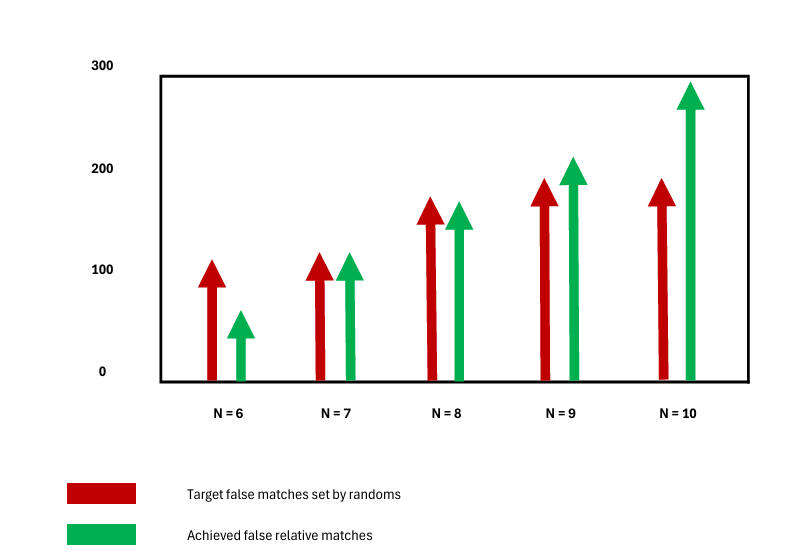
FINDING THE VALUE OF N
To achieve 219 false segment-matches for both randoms and relatives, a value for N of 9 clearly works best. That relatives and randoms have the same number of false segment-matches is a corollary of the obvious assumption that the 187 extra relative segment-matches are all real.
The method here is to delete from the relative match-count all segment-matches from white and green relative pairs having less than N segment-matches, and then totalling the deleted segment-matches to compare with the target.
This method depends upon 2 elements - (1) the false segment-matches included in the yellow areas and (2) the real segment-matches included in the deleted areas - balancing each other. This is something unproven but which we judged reasonable because our triangulation discussion certainly shows a false segment-match in a yellow area, and indeed we know from genetic genealogy theory that not all 7cM segments are real. Further, as segment size diminishes, the probability of being false increases sharply accompanied by a rapidly diminishing (but non-zero) probability of the segment being true. In a family context, the adjustment to our estimate will be small given that both elements are small.