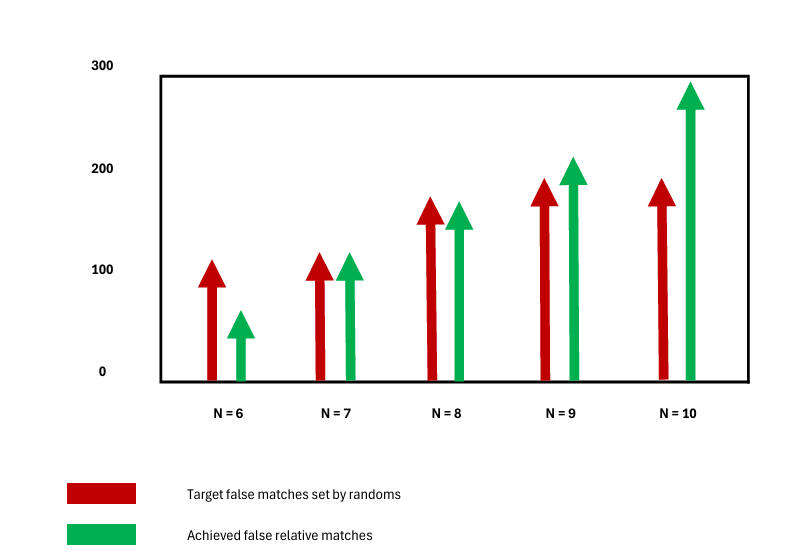
FINDING THE VALUE OF N
THE NUMBER OF SEGMENT-MATCHES WHICH PREDICTS A FAMILY CONNECTION
To achieve 219 false segment-matches for both randoms and relatives, a value for N of 9 clearly works best. That relatives and randoms have the same number of false segment-matches is a corollary of the obvious assumption that the 187 extra relative segment-matches are all real.
The method here is to delete from the relative match-count all segment-matches from white and green relative pairs having less than N segment-matches, and then totalling the deleted segment-matches to compare with the target.
This method depends upon 2 elements - (1) the false segment-matches included in the selected areas and (2) the real segment-matches included in the deleted areas - balancing each other. This is something unproven but which we judged reasonable - though perhaps the chance of false matches arising in the selected areas (mainly in the pairs with N or more segment-matches, but also including a few in yellow - for example where our triangulation discussion shows a false segment-match), is somewhat greater than real segment-matches being included in the discarded area, in which case the green arrows should be a little higher. This would not impair our conclusion and it might even bring N = 8 into play!